
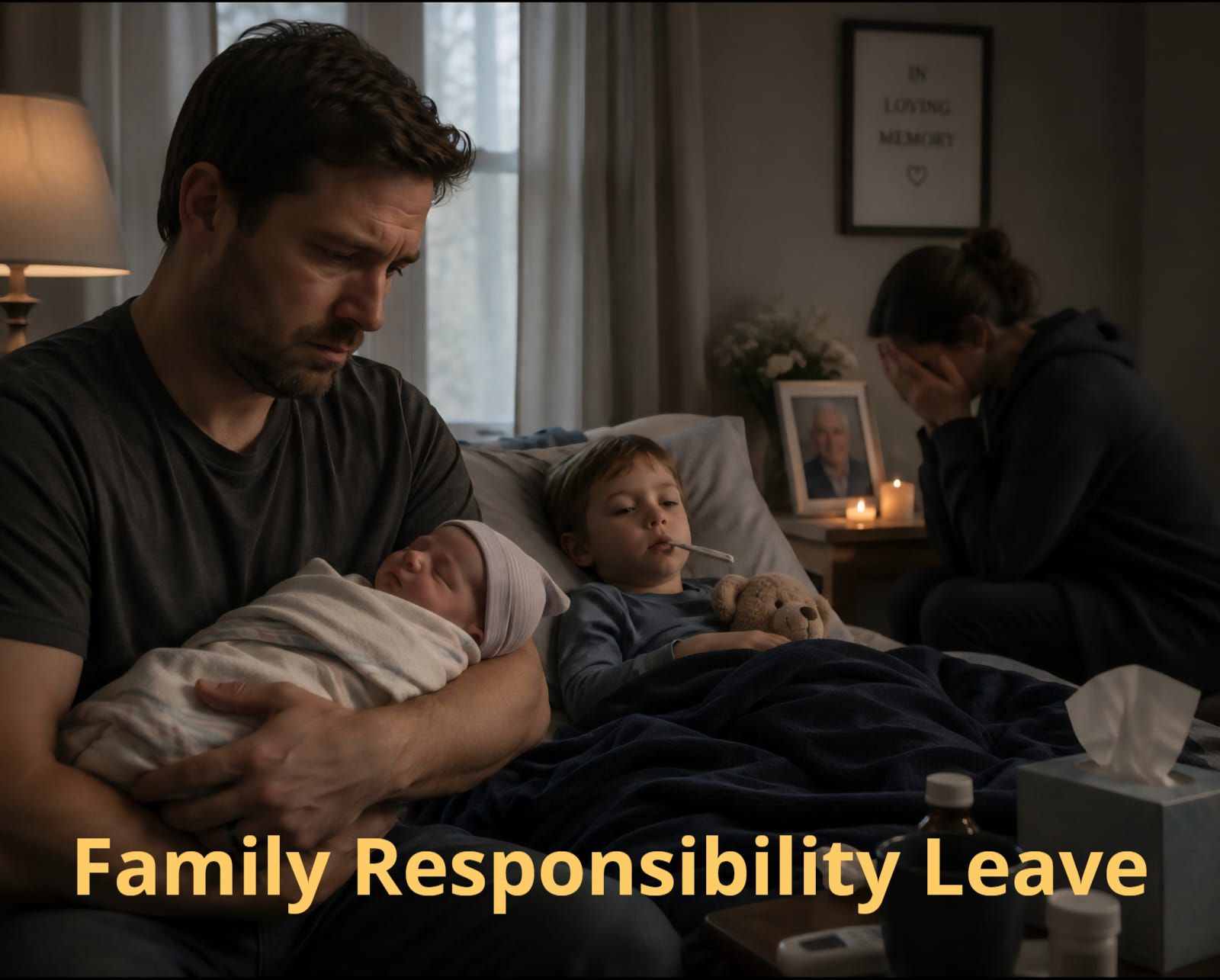
Only employees who have worked for longer than four (4) months with the same employer, and who are employed for four (4) days per week, qualifies for family responsibility leave (“FRL”).
This type of leave replaces what was previously known as paternity leave, special leave, compassionate leave or any other name that it was known by. This leave is in addition to any other leave entitlement and any unused portion lapses at the end of each cycle and is not accumulative.
FRL covers specific requirements – anything not mentioned in section 27(2) does not qualify for family responsibility leave. Basic Guide to Family Responsibility Leave
The provisions cover instances where:
The male employee’s child is born
The employee’s child or adopted child is sick (“child” is max 18 years old)
The death of the employee’s spouse or life partner, parent, adopted parent, child, grandchild, grandparent, or brother or sister. (no aunts, uncles, best friends or animals….!)
Male employees qualify for ten (10) days paternity leave. By implication in the law, the paternity leave needs to be taken as soon as his child has been born, and he may claim UIF for these ten (10) days as the leave is unpaid.
Just a note on illness – no other illness is covered under the section, e.g not an ill / sick spouse, parent or sibling. The employee must use annual leave for that purpose.
FRL may be taken as a part of a day or a whole day.
And of course, you, as the manager are entitled to demand evidence or proof when FRL is requested, such as a death certificate or medical certificate or certificate issued by the hospital.
This concludes the four (4) types of leave according to the BCEA.


Other types of leave which are NOT a legal requirement, may be granted, however, these leave types MUST be applied consistently in your business – preferably have a formal policy if you grant these leave types.
Study Leave is a matter for arrangement entirely between you, as the employer and the employee. Make sure the paperwork is done prior to studies being undertaken and the conditions are clear upfront.
Leave for religious holidays: at present the situation is that should an employee wish to take leave for the purpose of religious holidays other than an official public holiday, then the employee must take paid annual leave or unpaid leave. Any paid annual leave taken will be deducted from the employee’s annual leave entitlement.
Unpaid leave: is generally granted at the employer’s discretion, often used when an employee has exhausted their paid annual or sick leave, or via agreement for extended time off. It is not a statutory right to demand, but rather a voluntary arrangement or a consequence of unauthorised absence, where salary is deducted pro-rata based on working days. Calculation: based on the employee’s salary divided by the working days in that period. E.g. a monthly paid employee working 5 days/ week would have their salary divided by 21.67 to calculate daily deductions.
Let us know if you need any assistance on any of the leave types we explained.
Have a great weekend! (These 2 weekend days are not part of any leave 🤪)
Uluma HR Team


